Augusto Curry
Fiction
First Published: November 1, 2008
Original Language: Portuguese
Goodreads
This story begins even before it actually begins. In its introduction, the author informs us about his other works, how long he has been writing, and the amount of unpublished material he has produced.
Many people do not understand why my books are so sought after, when I am not attracted to propaganda, and, as much as possible, I lead a rather secluded life. Perhaps it is because of my journeys through the impenetrable world of the human mind. Frankly speaking, I do not deserve this success.
Such words certainly deserve attention. It is also worth mentioning the author’s wish that young people read his books as well, since they are, with some exceptions, “consumers of products and services.”
The story opens almost like a tragedy. Soon a character appears who has a solution. But even faster comes repetition, already on the first page. And rhetoric on the second.
Another human being wanted to shorten his already short existence. Another person planned to give up on life. It was a time saturated with sorrow. More people died by taking their own lives than in wars and murders.
The physical appearance of the main character takes up more than half a page. The man is described as mysterious, yet this adjective is subsequently repeated numerous times.
The second chapter begins. The hero tries to persuade the suicidal man, the narrator, not to do it. But he does not speak only to him. He speaks to the entire world. The chapter drags on. One would expect that in such situations there is not much time. Here and there, a glimmer of hope appears, both in the suicidal man and in the text:
He understood that no one can judge the pain of others.
Yet soon the monologue turns into something like a psychologist’s session or a university lecture.
I will answer you if you answer me first. From which philosophical, religious, or scientific source did you draw to justify the thesis that death is the end of existence? Are we living atoms that disintegrate never to re-form? Are we merely an organized brain, or do we have a psyche that coexists with the brain and transcends its boundaries? Which mortal knows this? Do you know it? Which believer can justify his thinking without using an element of faith? Which neuroscientist can justify his arguments without using the phenomenon of speculation? Which atheist or agnostic can defend his thoughts without any degree of uncertainty and without distortion?
This does not take place in a classroom or a comfortable armchair, but on the roof of a skyscraper. The suicidal man stands on the ledge, threatening to jump at any moment. Yet he must be persuaded, and the narrator calls this “great ideas.”
In the third chapter, Darwin’s theory is even mentioned.
Why did Darwin, in the final moments of his life, when he suffered unbearable nausea and vomiting, cry out ‘My God!’? Was he weak when he invoked God as his strength failed him? Was he a coward when he was disturbed by pain and, approaching death, considered it an unnatural phenomenon, even though his theory was based on the natural processes of evolution? Why did a serious conflict arise between his existence and his theory? Is death the end or the beginning? Do we disappear, or do we find ourselves within it? When we die, are we cast out of history like actors who will never perform together again?
How did the suicidal man even get there?
As a professor, he fell in love with a student fifteen years younger than him, bought her trivial gifts, and went into debt. His wife found out and left him with their child. Then he realized he loved her and his world collapsed. He cried, allegedly for the first time since his mother had died. His name was Júlio César. He still hasn’t jumped.
Chapter four ends. Júlio finally finds salvation in his savior, the Dreamseller, the master, as he calls him, and decides to submit to his teachings. This happens on page forty.
They go out into the world. Everyone who meets them must listen to yet another lecture, or rather participate in the so-called ego battle. The game consists of the protagonist emerging as the winner in every conversation.
Policeman: “What is your name?” he asked arrogantly.
Narrator: The man next to me (the Master) glanced at him discreetly, changed the subject, and shocked him with these words: “Are you not happy that this man changed his trajectory? (Did not kill himself.) Are you not pleased that he decided to save his life?” And he looked at me.
The cold policeman fell from the peak of power. He lost his composure. He did not expect his insensitivity to be exposed within seconds. Embarrassed, he formally said: “Yes, of course I am happy for him.”
All the people who reacted foolishly to the Master swallowed their own foolishness. They were encouraged to realize their superficiality and to smell the stench of their own folly. He continued his torpedoing:
“If you are happy, why not show it? Why not ask for his name and congratulate him? After all, is human life not more valuable than the building that shelters us?”
Three characters: the policeman, the Master, and the narrator. The policeman does his job but is accused of arrogance. The narrator appears to be highly biased and defends the Master. The Master, however, does not speak to the point at all. He is less characterized by intelligence than by excessive self-confidence, if not outright arrogance.
The story continues in a similar vein. But even more is revealed. The text already tried at the beginning to fight against ideologies, even religion. In reality, however, it looks different:
Socialists sacrificed millions of people for an ideal, but this Christ almost went mad for the little man and ‘went mad’ with joy when he found him.
Meanwhile, the book mentions how important it is to have one’s own dreams.
Then comes this:
I was amazed; I knew the power of criticism, but I was not aware of the power of praise.
What the text fights against, it paradoxically uses as its own weapon. Moreover, it becomes increasingly clear that both the narrator and the protagonist serve as mouthpieces for the author, allowing him to repeatedly digress into philosophical ideas, morality, and even preaching.
Through the study of the history of national wealth, I understood the sociological significance of this final idea. I realized that many who inherited or were given wealth achieved things without merit, did not value their parents’ effort, and squandered their fortune as if it were endless. Inheritance became a bond of a deceitful and superficial life. They focused on immediate gratification and sought to enjoy maximum pleasure in the present without foreseeing future storms.
The story thus becomes more of a vehicle for conveying ideas that would perhaps find a more natural place in an essay or a popular philosophical work. As a result, the plot is not very important, and the characters appear more as carriers of opinions than as real people.
How is it possible that the book achieved such success and was translated into dozens of languages?
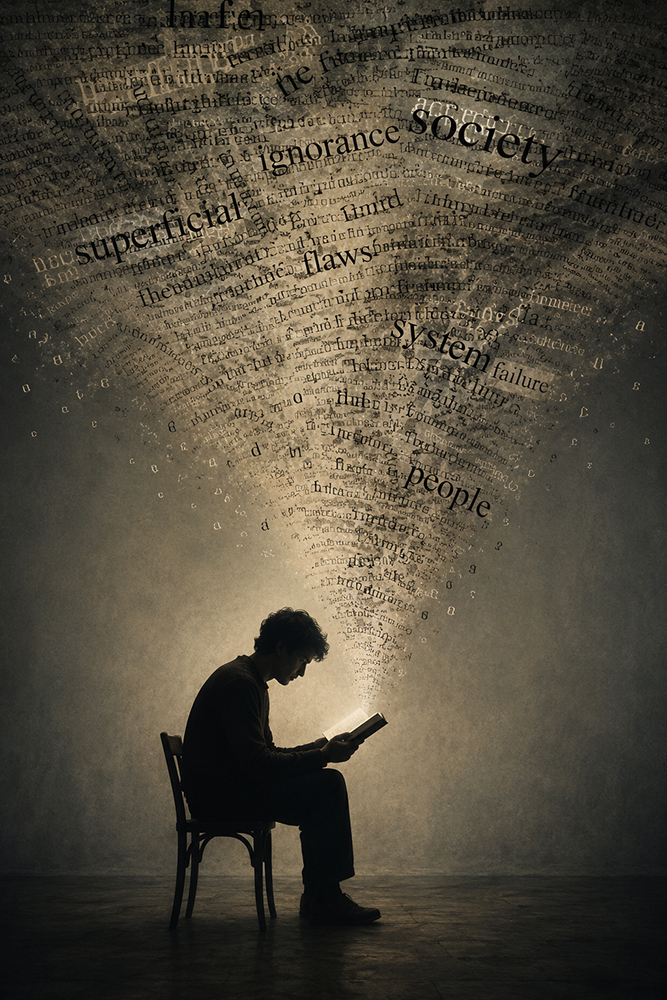
One possible reason may be its critical tone. The book repeatedly points out the flaws of society, the superficiality and ignorance of people, and the failures of the system. These themes are appealing to readers because they can easily identify with them.