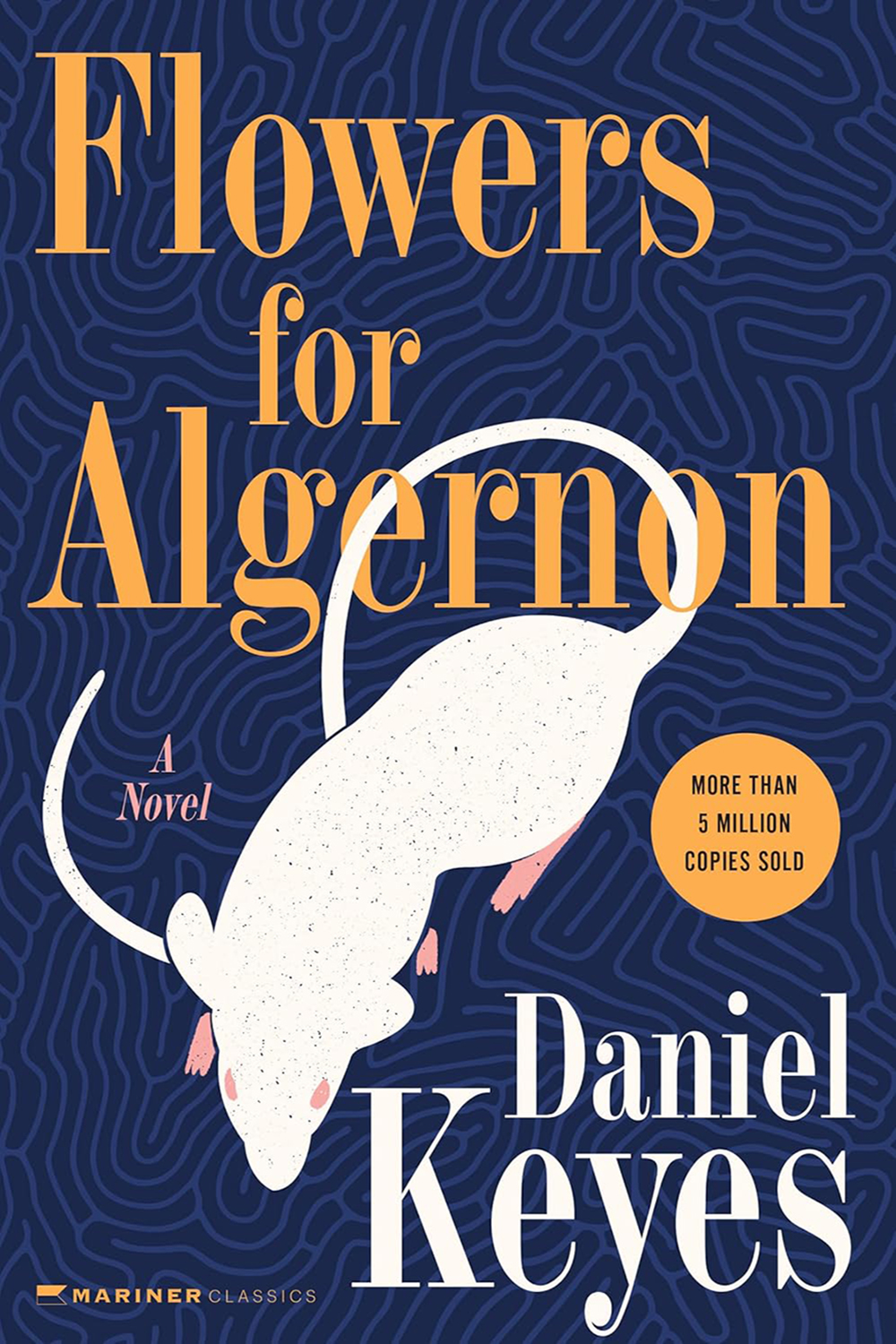
Daniel Keyes
Science Fiction
First Published: April 1, 1966
Original Language: English
Goodreads
It started so well. I quickly began to like Charlie. The way he spoke felt genuine and distinctive. I didn’t think of him as dumb. On the contrary, he showed real insight and seemed aware of the sense of superiority people feel toward those they consider inferior. He appeared to understand that intelligence and the desire for knowledge can stand in the way of true happiness. Yet I understood his wish to become smart. I felt for him and hoped he would make it.
And suddenly, Charlie was smart, even though they had told him it would take a long time. It didn’t. What I had expected to be the story’s central objective—his transformation—already occurred before the end of the first quarter. Charlie himself barely noticed. There was no celebration. Nothing. Instead, he simply became an ordinary, miserable human. Up to that point, the reading had still been enjoyable.
Then I began to feel that Charlie had perhaps gotten a bit too smart. Now he seemed intent on giving me lessons. He became so intelligent that, for example, he couldn’t resist mentioning the legendary D. Did he perhaps think he had already become a man with the same capacity? I had to pause and ask myself whether I was thinking about Charlie or the author.
Before I knew it, Charlie could read minds and was on his way to an IQ of 180. Alice surprised me too—or rather, disappointed me. First she says, “Not yet.” A while later, she initiates a kiss. Charlie knows why. He explains that Alice didn’t know who she was or which world she wanted to live in. Explanation, by the way, is something this book does very well. Charlie makes sure to repeat it, just in case we are stupid too—he knows how that feels.
By that time, I was already sure—I wasn’t reading a good book. I was watching an average, or even below-average, Hollywood movie from the ’80s–’90s. Too bad I was still only in the second quarter, and slowly but surely, I began to feel frustrated just like Charlie. And once Charlie’s father defended him, insisting to his mother that the erection wasn’t his fault, I lost all hope. This was only an introduction to the absolutely shallow characters, with their artificial dialogue, who would occupy roughly 200 pages.
There were all the clichés. The endless, repetitive dreams. The past. The family visits, which I had no doubt would happen. And most of all, the climax of having sex, yes, sex with Alice. This was the true arc of the book. Luckily, it took me only a few minutes to get there, as I hurriedly flipped through the pages, not wanting to delay the pleasure and not worrying at all that I might miss anything. Apart from Algernon (a terrible name) managing to run away from his cage, there was nothing.
However, I still noticed some subtle, peculiar details. The way words like sex, kissing, and nude are inserted whenever the opportunity arises, while still trying to appear innocent and indifferent, suggests another word: perversion. It is not overt, more like a mist, but it is there.
Psychologically, this book completely fails. Everything is possible, just like in fantasy. Arguments and many other conflicts have no real origin; they appear suddenly, like hallucinations—except that even hallucinations have a cause. There isn’t a single character who feels whole; they simply don’t make sense. I could only appreciate the ending, when Charlie returns to being stupid (smart) again. I even felt a certain amount of emotion. But that amounted to only about seventy pages out of three hundred.
This book suggests that even very poor art can be appreciated, sold, and later hailed as a measure of its own quality, as if quantity were proof of value. It shows that even award-winning books may fail to reflect their true worth, and that those who nominate them deserve to be questioned. I’m sorry—and I’m not.